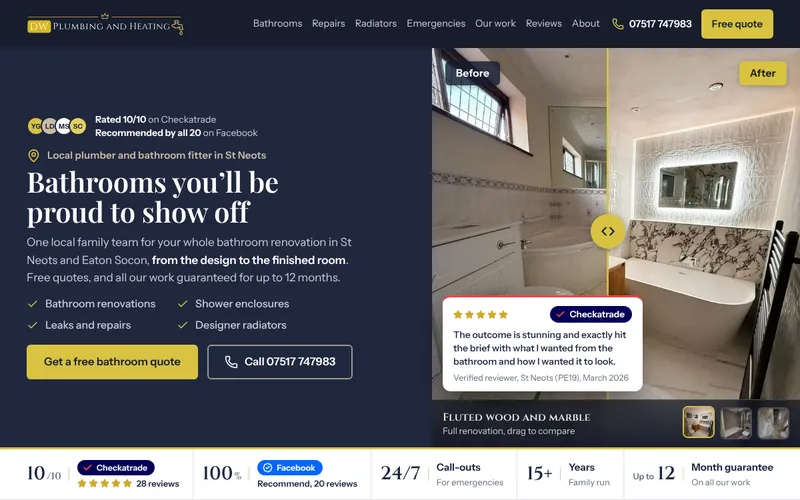
Why web design for roofers starts with trust
Roofers carry a reputation most of them didn't earn. Doorstep rogue traders, inflated quotes for "urgent" repairs, firms that vanish with the deposit: homeowners have heard the stories and read them in the local paper. So when they land on a roofer's website, they're not admiring the design. They're looking for reasons not to trust you.
That changes what a roofing website has to do. Before it sells anything, it has to prove three things:
- You're real. A trading address, a phone number with your name on it, your face, your vans and how long you've been going. A business that can be found again if something goes wrong.
- You're local. The towns you cover named plainly, and photos of roofs that look like the roofs on their street, not sun-bleached American shingles.
- Someone vouches for you. Reviews from local customers, accreditations they can check, and a guarantee in writing.
Say you're a roofer in Barnsley with fifteen years of good work behind you and a website that shows none of it. A homeowner comparing you with a firm that has a clear guarantee, a proper flat roof page and twenty captioned photos will probably ring them, even if your price is better. Good website design for roofers makes sure the proof you already have actually does its job.
Emergency repairs and planned roofs need different pages
A roofing website serves two people in very different states of mind.
The emergency
Water is coming through the ceiling, or the wind has just taken a row of ridge tiles. They're on a phone, probably standing in the garden looking up. They search "emergency roofer" or "roof leak repair" with their town, and ring the first roofer who looks local and picks up. The page they land on should be short: the towns you cover, whether you can put a temporary cover on today, and a phone number they can tap without scrolling.
The planned job
A re-roof, a new flat roof on the extension, a chimney that's needed sorting for years. These people take weeks. They read the page, look at the photos, get two or three quotes and come back. They want to know which materials you'd use, how long the scaffold will be up, what the guarantee covers and roughly what it might cost. A short quote form suits them, because they're often browsing in the evening.
Roofing also runs with the weather. Storm weeks bring a rush of urgent calls, and calmer spells are when people plan bigger jobs. A website built for both means the storm customer you help this winter remembers you when the whole roof needs doing.
Roofing website design: the jobs and the pages they need
Google ranks pages, not businesses. A roofing website with one "Services" page listing repairs, re-roofs, flat roofs, chimneys, leadwork, fascias and guttering gives Google nothing strong to rank for any of them. A page per job does.
| Job | What people type | What the page has to show |
|---|
| Roof repairs | "roof leak repair", "slipped tiles", "emergency roofer" | Areas, how fast you can come out, temporary covers, a call button |
| Re-roofing | "new roof cost", "re-roofing", "roof replacement" | Materials, time on site, scaffolding, guarantee, photos, a quote form |
| Flat roofs | "flat roof replacement", "EPDM roof", "GRP roof" | Which system you'd recommend and why, garages and extensions, guarantee |
| Chimneys and leadwork | "chimney repointing", "lead flashing repair" | Before and after photos, access, why chimneys cause damp patches |
| Fascias, soffits and guttering | "fascia replacement", "gutter repair" | Materials, colours, a guide price |
Then add a page for each town you genuinely work in, with roofs you've done there. Pages that only swap the town name won't do much for anyone. If you do commercial roofing as well, it gets its own section, with the types of building you work on, your health and safety accreditations and written-up projects, because a facilities manager checks different things from a homeowner. Pushing those pages up the results over time is what SEO for roofers is for.
NFRC, CompetentRoofer, TrustMark and your guarantee
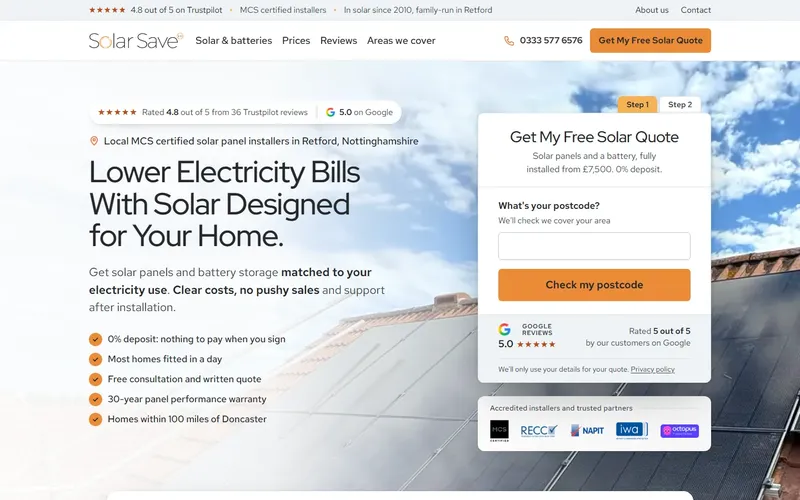
Accreditations matter more in roofing than in most trades, because they're one of the few ways a nervous homeowner can check you without asking a neighbour. Show the ones you hold, link to where they can be checked, and leave out the ones you don't.
- CompetentRoofer is a government-licensed competent person scheme for roofing in England and Wales. Members can self-certify that replacement roof coverings meet the Building Regulations, instead of the homeowner going through building control. The schemes authorised for re-roofing are listed on gov.uk.
- NFRC, the National Federation of Roofing Contractors, is the UK roofing industry's trade association, with over 1,350 members, and homeowners can search its member directory on the NFRC website.
- TrustMark is the government-endorsed quality scheme for work in and around the home, with its own search for registered tradespeople.
Your guarantee and insurance need words, not just a badge in the footer. What's guaranteed, for how long, what isn't covered, and whether it's insurance-backed if you offer that. Say that you carry public liability insurance. Specific, readable wording settles more nerves than any logo, and it's exactly the bit the cowboys never put in writing.
Photos, reviews and proof for roofers
Roofing is one of the few trades where the work photographs well, so use it:
- Before and after. The sagging, moss-covered roof and the clean new one. The cracked felt flat roof and the GRP that replaced it.
- Captions that tell the story. "Re-roof in natural slate, Holmfirth, eight days" tells people what you did, where and how long it took.
- Progress shots. Scaffold up, old covering off, new battens and membrane on. They show you don't cut corners where nobody can see.
- Reviews next to the job. A flat roof review belongs on the flat roof page. Never write reviews yourself or let anyone write them for you.
What a roofing website costs in 2026
This is what's being advertised to UK roofers and other trades as of October 2026:
| Route | Typical price | The catch |
|---|
| DIY website builder | Roughly £10 to £30 a month | You write, design and fix it yourself, after a day on the roof |
| Monthly trade website deal | Around £49 to £95 a month, sometimes plus a build fee | Often you don't own the site, so it goes when the payments stop |
| Freelance web designer | Usually £500 to £1,500, one-off | Quality varies, so check their work and who writes the words |
| Big agency | From around £5,000 | Built for bigger firms, and priced like it |
The website is £600 one-off, or £50 a month for 12 months, with no VAT and no deposit, and it's yours outright once paid. The first year's hosting is included. After that, hosting is £20 a month if you keep it with us. If one extra re-roof a year comes through it, it's paid for itself, but no website can promise you that job.
Some roofers buy leads instead. That can fill a quiet month, but you're paying for each one, often against other roofers, and they stop when the payments do.
Roofing website mistakes, and how we build yours
The same mistakes turn up on roofing websites again and again:
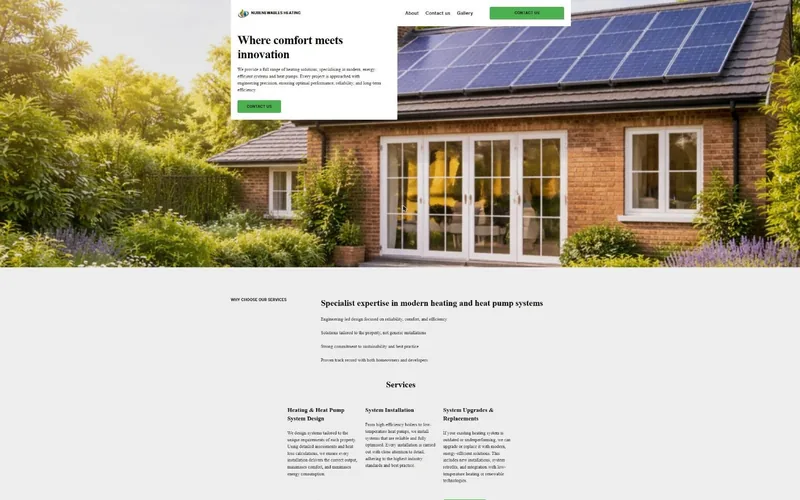
- Stock photos of perfect American houses, which make you look like you might not exist.
- No towns named, so customers and Google have to guess where you work.
- One services page for every type of roof.
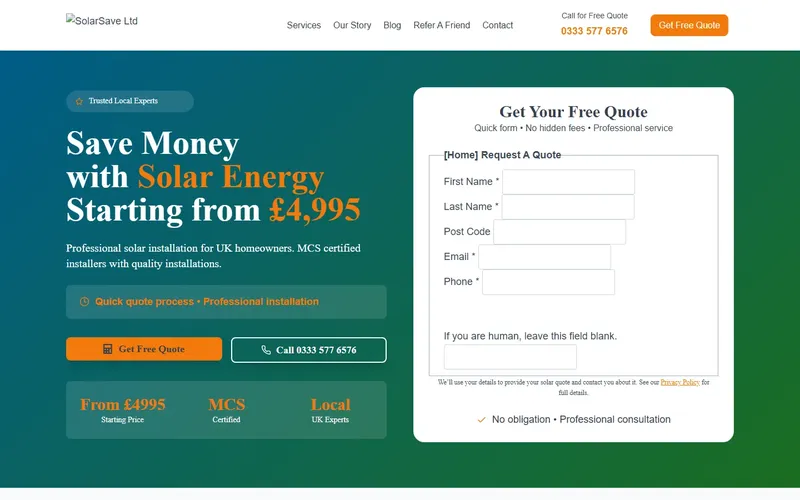
- A contact form that asks for everything except the problem, and no phone number you can tap on a mobile.
- "Fully insured and guaranteed" with no detail behind it.
- Logos for schemes you're no longer a member of. Customers do check.
Here's how we build a roofer's website instead, whether you work alone or run a roofing company with a few crews. On a short set-up call you tell us which jobs you want more of, which towns you cover and what you're accredited for. Your homepage design arrives within 24 hours of that call, before you pay anything. If you like it, you pay and we build the rest, live within 7 working days of your start date. Then we spend 90 days improving it based on what the tracking shows.
Everything that's included is on the main website page, and the bigger picture on winning more roofing work is on our page about marketing for roofers.







 Before
 After