Your own website
£600
once, or £50 a month for 12 months
That's about 14 to 20 exclusive leads at SolarSave's prices. After that the website keeps working, with no fee per enquiry. It's a platform you own.

Solar leads, explained honestly
Solar leads are homeowner enquiries you pay for. You can buy shared leads, exclusive leads or booked appointments. Or you can build your own with a website and Google. Buying is quick, but you pay again for every job. Building takes longer, and the enquiries come to you only.
Rented: a bought lead
New enquirySolar and battery quote
£ per leadSent to other installers too. Pay again next month.
Owned: your own website
New enquiryFound you on Google
£0 per leadyoursite.co.ukNo seller passes it on
Yours to keep. No fee per enquiry.
Google reviews
These are all 3 of our Google reviews. They're about website and Google profile work.
 Rated 5 out of 5 on Google
“Absolutely outstanding service, James has totally transformed my company website…”
Rated 5 out of 5 on Google
“Excellent service and very meticulous service!”
Rated 5 out of 5 on Google
“Amazing service from James can't recommend him enough... Really helped me setting up my business page. Goes above and beyond to make sure you're happy. Lovely guy as well. 10/10 service”
Buy or build
You don't have to choose one. You can keep buying leads while your own lead source grows, then put less of your marketing budget into leads as it takes over. The maths shows why it's worth starting the build now.
Your own website
£600
once, or £50 a month for 12 months
That's about 14 to 20 exclusive leads at SolarSave's prices. After that the website keeps working, with no fee per enquiry. It's a platform you own.
SEO to bring the visits
£495
a month, no contract
At SolarSave's prices, it pays for itself at around 15 to 20 enquiries a month, or 3 booked appointments.
Illustration, not a forecast. Bought leads stop the day you stop paying. A website and Google rankings keep bringing enquiries after the work is done. That's the whole case for building your own.
How to generate your own solar leads
Your own solar leads come from potential customers who search Google, find your business and contact you. No seller passes them on, and you don't pay per enquiry. This is your own lead generation, and here's the order we'd do it in.
1
Everything else points here, so it has to turn visits into survey requests. Give solar, batteries and each town you cover a page of their own. Put your MCS certificate and reviews up front. Use a short quote form that works on a phone. See what goes into solar website design, or our wider renewable energy web design.
2
This is the listing Google shows on the map when someone nearby searches for an installer. Choose the right categories, list your services and areas, and add real install photos. Google says businesses with complete and accurate info are more likely to show up in local results.4 We can set one up for £297.
3
SEO is the slow, steady part of your marketing. It moves your pages up Google for the searches homeowners make, like "solar panels" plus their town. It builds slowly, then keeps working without a fee per click. See how solar SEO works for installers.
4
Ask every happy customer for a Google review, and reply to each one. Google says more reviews and positive ratings can help your local ranking.4 Reviews also win the click when a homeowner compares installers.
5
A good install can lead to a neighbour, a battery later, or an EV charger. Make it easy: a thank-you, a card, and a page on your site for customers to send friends to.
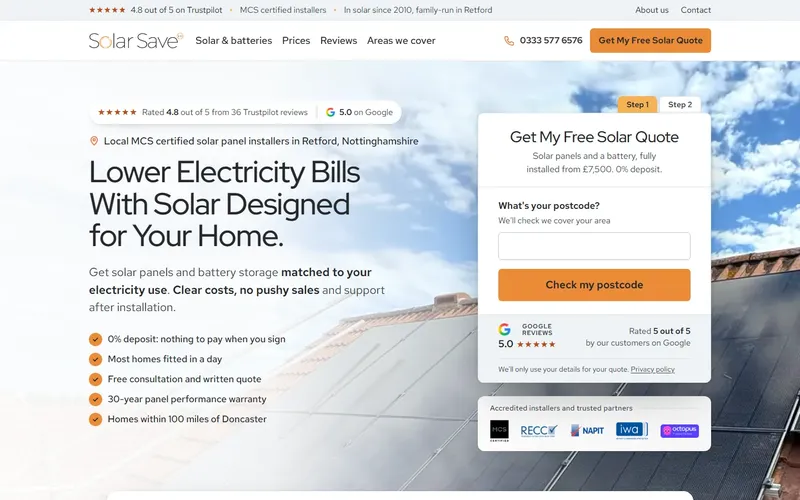
Real result · SolarSave, Retford
SolarSave's new website went live on 17 October 2026. In its first 11 days it brought in 6 enquiries, and 2 booked a call. At SolarSave's own lead prices, that's about £500 to £540 of enquiries they didn't have to buy.
The honest bit: it's early. Clicks from Google are still about 4 a day, because most of the new searches it shows for are on pages four to six for now.
See SolarSave's full resultsOur proof, written as it happens
SolarSave fit solar panels and batteries around Retford. They're having a new website, then six months of work on their Google rankings. The site went live on 17 October 2026, so this is the first few weeks of one client. The numbers come from Google Search Console, a local rank tracker and SolarSave's own records.
6enquiries
In the first 11 days, 2 of them booked a call. Worth about £500 to £540 at SolarSave's own lead prices.
19clicks
What the old site got in 16 months from people searching for solar in general. That's the problem the new site is there to fix.
14.47.1
Average map rank for "solar panels" round Retford, 10 to 19 October 2026. Lower is better.
The honest bit: clicks stayed at about 4 a day, because most of the new searches sat on page four to six. It's too early to say how many of the 6 enquiries found SolarSave through Google rather than already knowing the name. Most of the map move happened before the new site went live, and we don't know what caused it. This is one client and a few weeks, not a track record. See the full SolarSave results
What it costs
How it works
Today
Your business, what you install, and where you want work.
Within 24 hours
You see it before you pay a penny.
You decide
If you don't love it, you owe nothing.
7 working days
Every word written for you.
Who does the work
 James has done SEO for over ten years.
 Stephanie has 13+ years in the energy industry and leads our design and branding.
We take one installer per trade in the town where they're based. More about us
Is it right for you?
It's right for you if you can take on more work, and you're happy to build something that pays back over months.
It's not right for you if you need installs in the diary this week. Ads are quicker, and we'll say so.
What solar leads are
A solar lead is the contact details of a homeowner who has asked about solar panels. Sellers offer them to solar installers in three main forms. The difference is who else gets the same homeowner, and how much of the selling is done for you.
| Kind | Who else gets it | Published UK prices we found | What SolarSave pays |
|---|---|---|---|
| Shared leadOne homeowner, sold more than once | Other installers too. One supplier's solar products go to 1, up to 3 or up to 4 installers. Another shares each with one other installer.1 | Pricing is rarely published on its own. Ask how many installers get each one before you compare. | No figure |
| Exclusive leadSold to one installer only | Nobody else, if the supplier keeps its word. Get it in writing. | £8 to £15 a lead plus a weekly retainer at one supplier. £25 to £45 a lead at others.1, 2 | £25 to £35 a lead |
| Booked appointmentA survey or call already in the diary | Ask the supplier. You get a time in the diary, so less chasing. | £130 per booked appointment at one supplier.1, 2 | £200 an appointment |
Published UK prices, read on sellers' own sites in September 2026, next to what SolarSave pays.1, 2
Per lead £0 to £50
Per booked appointment £0 to £250
Prices change often and vary by area, volume and plan. Some exclude VAT. SolarSave's prices are from its case study. SolarSave is a solar and battery installer in Retford we work with.
Sellers often call their leads qualified, sometimes after a check by their own call centre.1 A qualified solar lead means someone answered some questions. It doesn't mean they are ready to buy.
A raw lead is a name and number someone else collected. An enquiry is a homeowner who contacted you directly. A booked appointment has a time in the diary. Each step costs more to buy, because more of the work is done for you.
What buying solar leads really costs
What one lead costs tells you very little. What matters is how many leads it takes to win one install. A cheap lead that rarely turns into a job can cost more than a high-priced one that often does.
Worked example, using SolarSave's prices
Say 1 in 8 exclusive leads turns into an install. That rate is an example, not a measured figure. Use your own.
Which? quotes Energy Saving Trust estimates that a typical 4.5kWp home solar panel system costs around £7,600 to install.3 So in this example, buying the lead costs under 4% of the job, every single time. That doesn't sound like much until you add up a year of it.
Your cost per job
Cost per job£240
Spend a month on leads£960
Spend a year on leads£11,520
Your own website is £600 once, or £50 a month for 12 months. It doesn't charge you per enquiry.
Solar lead generation, explained
Solar lead generation is marketing done by someone else. It means getting homeowners to ask about solar power, then passing their details to solar companies. The homeowner usually fills in a form on a website that isn't yours. These are the main routes UK sellers describe.
A homeowner asks for solar quotes on a comparison site. One UK marketplace says it generates solar leads from a network of hundreds of home improvement websites and blogs.1
Some specialist sellers run their own websites, then check each homeowner by phone in their own call centre before passing the details on.1
Trade directories and job platforms charge in different ways. Depending on the platform, you pay a monthly membership, a fee per job you respond to, or credits you buy in packs.1, 2
Some installers run their own Google or Meta ads.1 Ads bring enquiries quickly. You pay for the ads, and the enquiries stop the day the budget stops.
A platform may sell credits instead of a figure per lead. One sells credit packs without showing what a credit costs in pounds.2 Work out what one lead really costs you before you top up.
The catch with every route above: the homeowner found the seller's marketing, not you. Bought lead generation is rented: when the sale is over, you own nothing. Next month you pay again.
Worth it?
Buying leads isn't wrong. It can fill a diary fast. SolarSave, a solar business we work with, buys leads too. The real question is whether bought leads should be your only source of work.
Bought or your own
Whichever route you choose, the leads only pay off if they become surveys and sales. If you want leads that convert, start with a fast, clear reply. One seller's own guide lists slow replies as a reason they fail to convert.1 And a 2011 Harvard Business Review study of online sales leads found "most companies are not responding nearly fast enough".5
This matters most with shared leads, where other installers may be calling the same homeowner. But every enquiry is an opportunity, so it pays with your own too.
Set alerts so each new one reaches your phone. Call straight away if you can, and text if they don't pick up.
Offer two times while you have them on the phone. Book it there and then, rather than promising to call back.
A clear quote with the system size, the price and what happens next. Then follow up a few days later.
A CRM system is software that keeps your records in one place: where each came from, when you called, and what it became. A spreadsheet is fine to start. It also shows your conversion rate: how many leads become surveys, and how many surveys become sales.
What to log for every lead
| Source | Cost | Called in | Survey? | Won? |
|---|---|---|---|---|
| Bought, exclusive | £30 | 4 min | Yes | Yes |
| Your website | £0 | 10 min | Yes | Waiting |
| Bought, shared | ? | 2 hrs | No | No |
Example rows, not real data. After a month or two, your own records show the average cost per job for each lead generation platform and route, so you know which to keep.
If you still buy leads
Ask these before you hand over any money. Get the answers in writing.
Questions 1 to 5 follow the questions UK price surveys of renewables sellers suggest.1, 2
Other markets
Heat pump leads are sold in the same ways as solar leads. One supplier's published prices for ground source heat pump leads ran from £35 to £75 a lead, with a minimum order of 10, and only for MCS certified installers.2 Another sells exclusive air source heat pump leads that it says are never resold, with nine days to claim a replacement for an unqualified lead.2
If you fit batteries, ask suppliers whether they sell battery leads on their own, or only as part of a solar lead.
The build route is the same for every trade: a website that shows your credentials and offers, then Google. If you install heat pumps or boilers, see our websites for heating and gas engineers.
Commercial solar leads cost more than residential solar leads, and the sale runs far longer. UK sellers we read on 3 November 2026 publish from £150 an enquiry, and £250 to £1,000 plus VAT per attended meeting. One says deals can take 6 to 12 months. Our commercial solar leads guide compares the routes.
Related services
Questions
Something else? Ask us. You'll get a straight answer from James or Stephanie, usually the same day.
Ask us on WhatsAppThey can be, if you track cost per job and it stays well below what an install earns you. They work best as a top-up while you build your own source of solar enquiries, not as your only one.
Published prices we found in September 2026 ran from £8 to £15 a lead plus a weekly retainer at one supplier, to £25 to £45 a lead at others, and £130 per booked appointment at one supplier. SolarSave, a client of ours, pays £25 to £35 per exclusive lead and £200 per booked appointment.
Often, because you aren't racing other installers to the same homeowner. They cost more per lead, so compare the cost per job, not the cost per lead.
It's the marketing that gets homeowners to ask about solar: websites, ads, directories and call centres. Sellers do it and charge you for the results. You can also do it yourself with your own website and Google, and keep every enquiry.
Start with a website built to win jobs, then your Google Business Profile, then SEO and reviews. Our solar website design page shows what the website needs.
It depends on your area and how many installers chase the same searches. SolarSave's new site brought 6 enquiries in its first 11 days, while most of its new Google positions were still on pages four to six. That's why we suggest keeping some bought leads while yours grows.
No. We build your own lead source: the website first, then SEO if you want it. The enquiries go straight to you and nobody else. We take on one installer per trade in each area. That means the town where you're based. It doesn't cover everywhere you're willing to travel.
SolarSave's figures are from its case study (last updated 27 October 2026), with lead prices supplied by SolarSave.
Your own lead source
Tell us about your business and we'll design your homepage free, within 24 hours. No card details, nothing to sign. If you like it, the full website is £600 and live within 7 working days. We reply personally, seven days a week, 6am to midnight.